





Tennessee resource guide (pilot)
SteadRoute
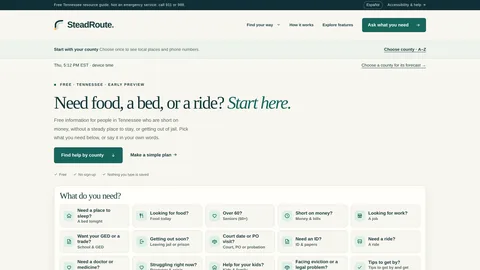
A free Tennessee guide for people leaving jail, without housing, or short on money (pilot).
WebApp by GVP · my own product, not client work.
Tennessee’s reentry help, in one place. Type what you need in your own words and get a source-linked next step for any of the state’s 95 counties. Free, no account, nothing saved.
- Tennessee counties covered
- 95
- Places mapped
- ~5,400
- Public data, with gaps labelled
- Plain-language legal guides
- 11
- Nothing you type is saved
- No sign-up
- Pages in the recorded accessibility sweep
- 27
- Automated checks on desktop and phone-sized screens


- Industry
- Tennessee resource guide (pilot)
- Year
- 2026
- What I did
- Product design
- Plain-language writing
- Public-data pipelines
- Supabase with row-level security
- Accessibility testing
- Deployment
- Stack
- Next.js
- React
- TypeScript
- Supabase (Postgres, row-level security)
- OpenStreetMap
- HUD Fair Market Rent API
- Playwright + axe-core
- Vercel
The challenge
What the business needed.
I started SteadRoute because of what I saw during my internship, especially around drug court. The people I saw there were trying to do the right thing, and what kept tripping them up was usually practical: getting to the next court date or check-in, finding a meal or somewhere to sleep, and knowing where to even start. The help existed, but it was scattered and hard to find when you needed it most.
In Tennessee that help is spread across agency sites, PDFs and phone trees in 95 different counties. Someone just released with $90 and no phone can’t spend hours searching, so SteadRoute puts source-linked next steps for every county in one place, in plain language, with nothing to sign up for.
The solution
What I built.
Ask in your own words
Type it how you’d say it, slang and typos included. A deterministic parser understands the situation (cash, phone, ID, a court or probation date, kids, a kitchen or not) and returns food, money, shelter, health and legal next steps, each with its source. No paid AI, and nothing typed is sent to a server or saved.
Every county, with honest gaps
About 5,400 places (food, pharmacies, 24-hour stops, libraries, transit and more) from OpenStreetMap, plus official THDA shelter and homeless-coalition contacts, stored in Supabase with row-level security. Where a county has none of something, it shows the nearest county’s and says so.
Plans built around real limits
Money and food plans depend on how much cash you have, whether you can cook or keep food cold, and the time of day. A release planner assumes you’re leaving that county’s jail, with a choice where a county has more than one, and covers what to ask for before you walk out.
Rights and rebuilding
Plain-language guides to getting a driver’s license back, clearing a record, voting rights, child support changes, veterans’ help, renting rights, immigrant safety, medical debt, young people leaving detention, SSI and certified recovery homes, each linked to official sources.
Urgent help comes first
Crisis and abuse questions put help at the top: 988 and the Tennessee crisis line for any mention of suicide, and a domestic-violence program for 94 of the 95 counties from the state coalition’s directory, with the statewide 24/7 line everywhere. Every phone number on the site is tap-to-call.
County gaps filled, and labelled
Every county page lists a public dental clinic (its own or the nearest), free showers and laundry where one has been checked, and otherwise the closest low-cost gym with showers, with its published price and a plain warning to use it only to work out and shower.
Rent that fits your pay
Compares your pay with HUD’s 2027 Fair Market Rents for every county using the 30%-of-income rule; the math runs in the browser. Crime appears only as a link to official TBI data with its limits, never as a safe or unsafe score.
Tested on phones and desktops
A sweep of 27 pages on desktop and a phone-sized screen checks automated WCAG 2.1 AA rules, sideways scrolling, tap-target size and the main flows (Ask, the release plan, the rent tool, the menu and county pages). Core content works without JavaScript.
Under the hood
How it works.
A visitor types their situation in their own words, or picks their county.
The words are read in the browser by a deterministic parser; nothing typed is sent or saved.
Matching next steps come from source-linked guides and plans for cash, cooking access and time of day.
Nearby places and shelter contacts load from a public, read-only Supabase table for that county and its neighbours.
Where a county has none of something, the nearest county’s listing is shown and labelled.
What the owner controls
- Guides and situations live in versioned code with an official source for each fact
- County places and shelter contacts are refreshed by scripts and loaded with a logged, sequential database change
How inquiries work
There are no accounts. Ask runs in the browser; a separate issue-report form stays off until moderation is in place.
What does the work
- Deterministic Ask
- A rules-based parser and slang normaliser map messy phrasing to needs, money and constraints, with no paid AI model.
- Public data, row-level security
- Places and shelter contacts sit in Supabase tables that the public can read but never write.
- Nearest-county fallback
- Missing categories are filled from the nearest county by distance between county centres, and labelled.
- Desktop and phone sweep
- An automated script checks 27 pages and the main flows for accessibility, overflow and tap-target size.
Lighthouse record
Measured, not estimated.
Only categories that were actually tested are shown with a score. A dash means that category has not been recorded yet. Scores change over time, so treat these as a dated snapshot.
Mobile
Tested November 13, 2026 · Lighthouse 12.8.2 CLI · median of 3 runs · original report (opens in new tab) · Live pilot intentionally uses noindex; SEO is 63. Local macOS runner, default simulated throttling.
Desktop
Tested November 13, 2026 · Lighthouse 12.8.2 CLI · median of 3 runs · original report (opens in new tab) · Live pilot intentionally uses noindex; SEO is 63. Local macOS runner, default simulated throttling.
What this project shows
Skills on display.
- Turning messy, real-world phrasing into structured needs without a paid AI model
- Building on public data for all 95 counties while labelling gaps instead of hiding them
- Row-level security on a public read-only database
- Plain-language writing tied to official sources, with honest limits
- Accessibility and mobile testing as part of every change


Need something like this?
One-time fee, a fixed quote, and you own the code, domain, and hosting.