





EdTech SaaS
ReasonFeed
Live · Real students using it
An adaptive LSAT practice app with a social-style feed and live quiz duels.
WebApp by GVP · my own product, not client work.
Launched October 2026. 20 students have signed up, three of them now on paid plans, and the first paid subscriber came 10 days after launch. As of November 18, 2026; signups count confirmed accounts only, and paid plans count active subscriptions.
My own product: LSAT prep rebuilt as a social-style feed, with an adaptive algorithm, live quiz duels, and plans you can cancel in one tap.
- Student signups
- 20
- Confirmed accounts · as of November 18, 2026
- Students on paid plans
- 3
- Active subscriptions · as of November 18, 2026
- From launch to the first paid subscriber
- 10 days
- Original practice questions
- 534
- Desktop Lighthouse performance
- 100/100
- November 2, 2026 · median of 3


- Industry
- EdTech SaaS
- Year
- 2026
- What I did
- Product design
- Adaptive feed algorithm
- Original question bank
- Spaced repetition
- Live quiz duels
- Subscriptions and billing
- AI tutor with usage limits
- Offline-ready web app
- Light and dark mode
- Social share images
- Privacy policy and terms
- Deployment
- Stack
- Next.js
- TypeScript
- Tailwind CSS
- Supabase (Postgres, row-level security, Realtime)
- Stripe
- Vercel
The challenge
What the business needed.
Most people studying for the LSAT already spend hours a day scrolling a feed on their phone. The usual study tools ask them to put the phone down and open a heavy course, a PDF, or a question bank that looks like a spreadsheet. ReasonFeed turns that habit around: the feed is the study tool. Every post is a practice question or a reading passage, and every swipe is a rep.
It also had to be honest about what it is. Official LSAT questions belong to the Law School Admission Council and are licensed, so ReasonFeed doesn’t copy, scrape or paraphrase them. It needed its own question bank, a clear trademark notice, and billing simple enough that nobody feels trapped in a subscription. This is my company, not client work.
The solution
What I built.
Live quiz duels
Users can send a friend an invite link or get matched with an anonymous stranger for a live five-question duel. Both players see the same questions at the same time, and points come from right answers plus a bonus for speed, Kahoot-style. Strangers appear only as names like “Anonymous Owl”; no name or email is shared, and nothing about a duel is saved.
A feed that learns what costs you points
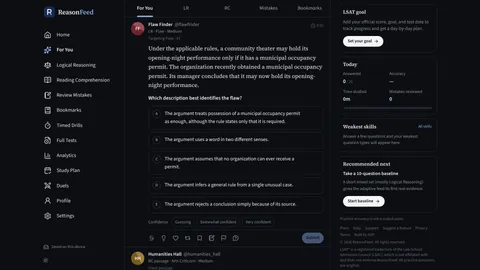
The For You timeline is built by an algorithm, not a fixed list. It tracks accuracy by question type (Flaw, Necessary Assumption, Strengthen and so on), smooths small samples so one bad answer doesn’t swing a whole category, and counts only first attempts as real evidence, so a memorized repeat doesn’t look like progress. Weak types get more of the feed, mistakes come back on a spaced-review schedule timed to land before the user’s test date, and difficulty rises only on fresh correct answers.
Original questions only, no LSAC content
Every Logical Reasoning question and reading passage is written for ReasonFeed, each with a full breakdown of why the right answer is right and why every wrong one is wrong. Nothing is copied from LSAC or scraped from LawHub, and the footer states that LSAT is LSAC’s trademark and that LSAC doesn’t endorse the app. Practice accuracy is never presented as a scaled score.
Billing that’s easy to leave
Monthly, yearly and lifetime plans run on Stripe with tax shown as tax. Cancelling, resuming, and upgrading all happen inside ReasonFeed with one confirmation, not a support email or a maze of retention screens. A cancelled plan keeps full access until the paid period ends, then drops to the free plan. Deleting the account cancels any subscription and erases the data immediately.
Likes, reposts and bookmarks that steer it
The social buttons do real work. Liking a question shows more of that type; reposting one counts double and brings that exact question back around. Bookmarked questions lead the feed until the bookmark is removed, so the hardest material stays in front of you until you decide you’re comfortable with it. Question types you keep getting right fade into the background.
Built for doomscrollers
It looks and moves like the apps people already use: questions are posts from study “accounts” like Flaw Finder and Humanities Hall, there’s pull-to-refresh, swipes between the For You, LR and RC timelines, a side menu that slides in from the left, and a profile page of everything you’ve liked, reposted, bookmarked and commented on. An optional slice of landmark cases, legal Latin and law-career facts (each with its source) breaks up the questions, and users choose how much of it they see.
Study anywhere, even offline
It installs to a phone’s home screen like an app, with no app store needed, and a help page walks through it for iPhone, Android and desktop. Progress is saved on the device first and synced across devices when a connection is available, so a subway tunnel or a flight doesn’t interrupt a session. Each account keeps its own copy on a shared device, and progress made before signing in is only added to an account when the user says it’s theirs.
An AI tutor with guardrails
Paid users can ask an AI tutor to explain a question. It is limited to LSAT reasoning, has a 30-message daily cap per account and a service-wide daily ceiling so costs stay bounded, and stops rather than guesses when those limits can’t be checked. Harmful or off-topic requests are refused; repeated harmful ones pause only the tutor while a person reviews them. Nothing about a refusal cancels anyone’s plan.
Paid questions stay on the server
Visitors’ browsers only ever receive the free sample. The full question bank, with its answers and explanations, is sent only after the server confirms the account has full access, and a check after every build fails it if any locked question shows up in the code sent to browsers.
A share preview for every page
Each page has its own social sharing image showing the logo, the page’s headline and a sample question card, including each reading passage and duel invite links.
Under the hood
How it works.
A visitor opens the app and practises a limited free sample, or signs up for a free account.
Each answer, its timing and confidence are saved on the device first, then synced to their account.
The feed algorithm reweights question types from first-attempt accuracy, likes, reposts and bookmarks.
Missed questions are scheduled for spaced review before the user’s test date.
Upgrading opens Stripe checkout; a webhook is the only thing that grants or removes full access.
What the owner controls
- Plan status, cancel, resume and upgrade, all inside Settings
- Study goal, test date, daily targets, timing accommodations and feed mix
- Data export and full account deletion
How inquiries work
Support and feature suggestions open a pre-addressed email in the user’s own mail app.
What does the work
- Adaptive feed
- Smoothed skill estimates, first-attempt-only evidence, spaced review and engagement signals decide what comes next.
- Per-user data isolation
- Database row-level security keeps every user’s attempts, notes and reactions private.
- Live duels
- Realtime presence pairs players and broadcast keeps both screens in step; questions come from a shared seed.
- Webhook-driven billing
- Stripe events are verified and tagged, so access always matches what was actually paid.
Lighthouse record
Measured, not estimated.
Only categories that were actually tested are shown with a score. A dash means that category has not been recorded yet. Scores change over time, so treat these as a dated snapshot.
Mobile
Tested November 2, 2026 · Lighthouse 12.8.2 CLI · median of 3 runs · original report link not saved
Desktop
Tested November 2, 2026 · Lighthouse 12.8.2 CLI · median of 3 runs · original report link not saved
What this project shows
Skills on display.
- Designing a recommendation algorithm around real learning signals, not engagement alone
- Real-time multiplayer over presence and broadcast channels, with no game server
- Subscriptions, upgrades and cancellation handled in-app through Stripe webhooks
- Local-first data that works offline and syncs when a connection returns
- Respecting copyright with an original content bank and plain trademark notices
- Putting hard limits on an AI feature so it can’t be abused or run up costs
- Gating paid content on the server instead of hiding it in the browser


Need something like this?
One-time fee, a fixed quote, and you own the code, domain, and hosting.