





EdTech SaaS
AxonFeed
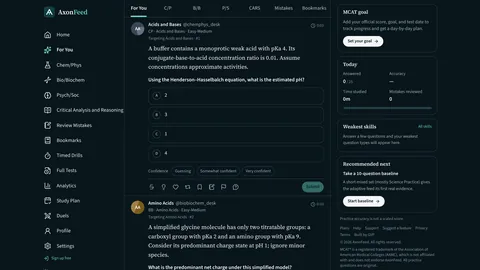
An adaptive MCAT practice app with a social-style feed, exam-length timed sections and live quiz duels.
WebApp by GVP · my own product, not client work.
My own product: MCAT practice in a social-style feed, built on the ReasonFeed engine with its own content, accounts, database and billing.


- Industry
- EdTech SaaS
- Year
- 2026
- What I did
- Product design
- Adaptive feed algorithm
- Original question bank
- Spaced repetition
- Timed sections and endurance drills
- Live quiz duels
- Subscriptions and billing
- AI tutor with usage limits
- Offline-ready web app
- Light and dark mode
- Social share images
- Privacy policy and terms
- Deployment
- Stack
- Next.js
- TypeScript
- Tailwind CSS
- Supabase (Postgres, row-level security, Realtime)
- Stripe
- Vercel
The challenge
What the business needed.
The MCAT is a seven-and-a-half-hour exam across four sections: chemistry and physics, biology and biochemistry, psychology and sociology, and critical reading (CARS). Students prepare for months, mostly on their phones between classes and shifts. AxonFeed brings the ReasonFeed idea to that exam: the feed is the study tool, and every post is a problem or a reading passage.
Reusing an engine is only safe if nothing else is shared. AxonFeed needed its own database project, its own sign-in, its own Stripe products and its own branding, so a bug or a billing event in one app could never touch the other. And like ReasonFeed, it had to be honest: official MCAT material belongs to the AAMC, so every question is original, and nothing claims to predict a score. This is my company, not client work.
The solution
What I built.
One engine, fully separate products
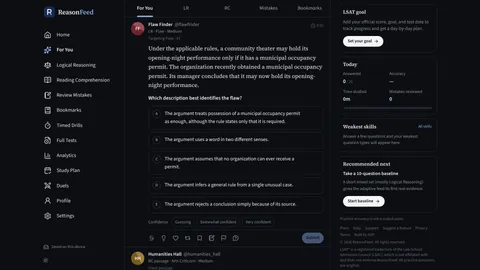
AxonFeed runs on the same adaptive feed, sync and billing code as ReasonFeed, but on a separate database project, separate accounts, separately named tables and its own Stripe products, coupons and customer portal. Payments carry an app tag, so a webhook from one product is ignored by the other.
A feed weighted like the exam
The For You timeline tracks accuracy by topic in each section, counts only first attempts as evidence, and brings missed problems back on a spaced-review schedule. Three quarters of fresh questions come from the science sections and one quarter from CARS, counted by question rather than by post, since one CARS passage carries several questions.
An original, clearly labelled bank
180 science problems across the three science sections and 9 short CARS passages with 54 questions, each with a full explanation. None of it is AAMC material, the footer states that MCAT is the AAMC’s trademark, and the app says plainly that the bank is not calibrated to the official exam and that practice accuracy is not a scaled score.
Exam-length practice
Timed sections run at the real lengths, 95 minutes for each science section and 90 for CARS, and an endurance drill strings 230 questions together with optional breaks. Official AAMC practice-test results are logged separately, so real scores and app accuracy are never mixed.
Paid content stays on the server
Free visitors’ browsers receive only a 15-question science sample and two CARS passages. The full bank is sent only to accounts with full access, and a check after every build fails if any locked question appears in the code sent to browsers.
An AI tutor with limits
When it’s switched on, full-access users can ask an AI tutor about the problem in front of them. It has a daily cap per account and a service-wide ceiling, refuses unrelated or harmful requests, and stops rather than guesses when its limits can’t be checked. The written explanations work with or without it.
Built for phones, works offline
Swipeable section timelines, live five-question duels with a friend or an anonymous stranger, and install-to-home-screen with no app store. Progress is saved on the device first and synced when a connection returns, with each account kept separate on a shared device.
Under the hood
How it works.
A visitor practises a free 15-question science sample and two CARS passages, or signs up for a free account.
Each answer, its timing and confidence are saved on the device first, then synced to their account.
The feed reweights topics from first-attempt accuracy and keeps three quarters of questions in the sciences.
Missed problems are scheduled for spaced review; timed sections run at real exam lengths.
Full access unlocks the whole bank, sent from the server only after the account’s plan is checked.
What the owner controls
- Plan status, cancel, resume and upgrade inside the app
- Study goal, test date, daily targets, timing accommodations and feed mix
- Official practice-test results logged apart from app accuracy
- Data export and full account deletion
How inquiries work
Support and feature suggestions open a pre-addressed email in the user’s own mail app.
What does the work
- Separate from ReasonFeed
- Same engine, but its own database project, accounts, tables, Stripe products and app-tagged webhooks.
- Server-gated content
- Browsers get only the free sample; a post-build check fails if a locked question reaches client code.
- Exam-weighted feed
- Science and CARS are balanced by question count, with first-attempt evidence and spaced review.
- Live duels
- Realtime presence pairs players and broadcast keeps both screens in step; questions come from a shared seed.
Lighthouse record
Measured, not estimated.
Only categories that were actually tested are shown with a score. A dash means that category has not been recorded yet. Scores change over time, so treat these as a dated snapshot.
Mobile
Tested November 2, 2026 · Lighthouse 12.8.2 CLI · median of 3 runs · original report link not saved
Desktop
Tested November 2, 2026 · Lighthouse 12.8.2 CLI · median of 3 runs · original report link not saved
What this project shows
Skills on display.
- Turning one product into a second one without sharing data, accounts or billing
- Weighting a recommendation feed to match how an exam is actually scored
- Gating paid content on the server instead of hiding it in the browser
- Honest labelling of original, uncalibrated practice content
- Local-first data that works offline and keeps accounts apart on shared devices


Need something like this?
One-time fee, a fixed quote, and you own the code, domain, and hosting.