








Chess training web app
Chess Lab
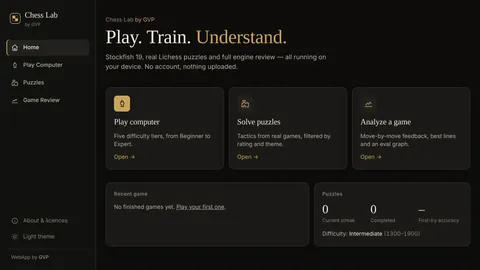
A chess training web app: play Stockfish, solve real Lichess puzzles and review games, all in the browser.
WebApp by GVP · my own product, not client work.
My own product: play Stockfish, solve real Lichess puzzles and review games move by move, all in the browser with no account and nothing sent to a server.


- Industry
- Chess training web app
- Year
- 2026
- What I did
- Product design
- Chess engine integration
- Puzzle data pipeline
- Game review and analysis
- Installable offline web app
- Open-source licensing
- Social share images
- Deployment
- Stack
- Next.js
- TypeScript
- Tailwind CSS
- Stockfish 19 (WebAssembly)
- chess.js
- react-chessboard
- Vercel
The challenge
What the business needed.
Most chess sites ask you to sign up before you can play the engine or review a game, and send every move to their servers. Chess Lab is the opposite: a single-player training app where the rules, the engine, the analysis and your progress all run and stay in your browser. No accounts, no tracking, no server processing.
That meant running a full-strength engine on a phone without freezing the page, using real puzzle data with clear licensing, and being honest about what the numbers mean. Difficulty levels are not Elo ratings, and move labels are local estimates, not any chess website’s official classifications. This is my own product, not client work.
The solution
What I built.
Stockfish 19 in the browser
The computer opponent and the analysis use Stockfish 19 (the lite, single-threaded WebAssembly build) loaded on demand into a Web Worker. Play, review and variation exploration each get their own worker, so one search can’t interfere with another, and replies that arrive after an undo or a restart are dropped.
Play the computer
Play White, Black or a random side across five difficulty tiers, with undo and redo, resign, draw offers, threefold and fifty-move claims, PGN and FEN import and export, and unfinished games restored after a refresh. A two-player mode on the same device is included too.
Real puzzles, clearly sourced
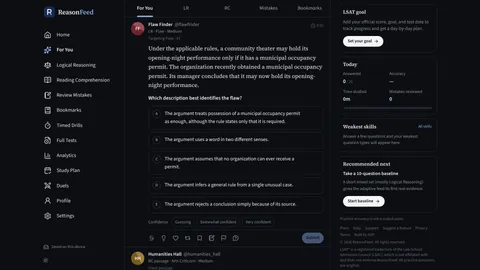
Over 5,000 puzzles from the Lichess Open Puzzle Database (CC0), picked by a deterministic script for quality and balance across ratings and themes, checked move by move, and kept verbatim. They load in small chunks, with a Puzzle of the Day, difficulty presets, 11 tactical themes, hints, and a streak and history saved on the device.
Move-by-move game review
Import a PGN or open a finished game and every position is analysed at a fixed depth, with an eval bar and graph, best-move arrows, the engine’s line, labels from Best to Blunder, key moments and accuracy estimates. Side variations can be explored on the board without touching the game, and an annotated PGN can be exported.
Installs like an app, works offline
A web manifest and service worker let Chess Lab install to a phone’s home screen or desktop with no app store. After the first visit, the engine, puzzles and pages work offline.
Licensing done properly
Stockfish is GPL-3.0, so the app’s own code is GPL-3.0-or-later too, the licence text ships with the engine files, and the About page links the exact engine source. Puzzle data is credited to Lichess, and the app says plainly that it isn’t affiliated with Lichess, Chess.com or the Stockfish team.
Under the hood
How it works.
A visitor opens the app; there is no sign-up and no account.
Stockfish loads on demand into a Web Worker on their own device.
Games, puzzle progress and preferences are saved in the browser’s local storage.
Game review analyses every position at a fixed depth and labels each move.
After the first visit, a service worker keeps the engine, puzzles and pages available offline.
What the owner controls
- Side, difficulty tier and game mode for every game
- PGN and FEN import and export, and an annotated PGN from each review
- Puzzle difficulty presets, a custom rating range and tactical themes
How inquiries work
There are no accounts or forms. Nothing a player does is sent to a server.
What does the work
- Isolated engine workers
- Play, review and variations each run their own Stockfish worker, created when needed and stopped when you leave.
- One game model
- A game is a start position plus a move list; everything else is replayed through chess.js, so an illegal move can never get in.
- Puzzle pipeline
- A script streams the Lichess dump, filters for quality, validates every solution and writes small rating-sorted chunks.
- Offline install
- A web manifest and service worker make it installable, with the engine and puzzles cached after the first visit.
Lighthouse record
Measured, not estimated.
Only categories that were actually tested are shown with a score. A dash means that category has not been recorded yet. Scores change over time, so treat these as a dated snapshot.
Mobile
Tested November 2, 2026 · Lighthouse 12.8.2 CLI · median of 3 runs · original report link not saved
Desktop
Tested November 2, 2026 · Lighthouse 12.8.2 CLI · median of 3 runs · original report link not saved
What this project shows
Skills on display.
- Running heavy computation in Web Workers so the page stays responsive on phones
- A single source of truth for game state, so the board, move list and PGN can never disagree
- Turning a multi-million-row public dataset into small, validated, lazy-loaded chunks
- Offline-first installable web apps with no accounts and no server
- Meeting open-source licence obligations when shipping a GPL engine to browsers


Need something like this?
One-time fee, a fixed quote, and you own the code, domain, and hosting.