

SaaS + website
NightShift Hotels
Multi-property AI voice operations, with a dashboard for each hotel.
My own company, not client work.
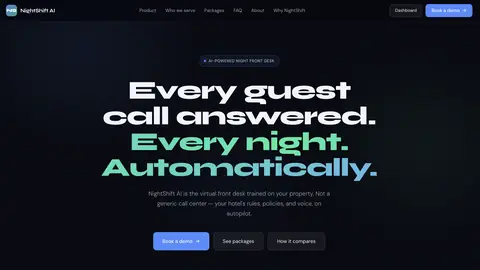
My own company: an AI front desk that answers hotel calls after hours, with a dashboard for every property and the marketing site that sells it.


- Industry
- SaaS + website
- Year
- 2025
- What I did
- Product design
- AI voice agents
- Multi-property dashboards
- Database design
- Serverless back end
- Subscriptions and billing
- Marketing site
- Light and dark mode
- Guided website chatbot
- Deployment
- Stack
- Supabase (Postgres, row-level security)
- Serverless functions
- Stripe
- Retell AI voice
- HTML/CSS/JavaScript
- Vercel
The challenge
What the business needed.
Hotels lose bookings when calls go unanswered after hours, and small properties can’t staff a night desk. NightShift is my own product that answers those calls with an AI voice agent and puts every call in front of the hotel the next morning.
It had to work for many hotels at once without one property ever seeing another’s guests, take payment for plans and trials, and still be explained in plain words to owners who have never bought software like it. This is my company, not client work.
The solution
What I built.
One idea per section
The marketing site walks a hotel owner from the problem (missed calls) to what NightShift does and how to try it, without jargon.
A menu that previews the product
An accessible mega menu groups the product pages and the resources (case study, staffing cost calculator, blog, FAQ) into panels with a one-line description each, plus a shortcut to the demo calls and the $99 trial. It opens with a mouse, a tap, or the keyboard, and becomes simple accordions on phones.
Light or dark, the visitor’s choice
Every page, including the intake form, the card field at checkout, and the subscription agreement, starts in the light or dark appearance set on the visitor’s phone or computer, and a sun and moon button in the header switches it and remembers the choice. The theme is applied before the page draws, so it never flashes the wrong one. Both themes were checked page by page for contrast, and the dashboard previews stay dark in both.
A guide that walks owners to the right page
A chat window offers guided paths: what it costs, which plan fits a property’s room count, how the trial works, setup, guest data, and how to reach a person. Owners tap a suggested question or type their own. It uses no AI: every answer is written from the pricing and FAQ pages, and when it is not sure it says so and offers an email address or a demo instead of guessing.
A share preview for every page
Each page has its own social sharing image built from its own content: the two plans and the trial price for pricing, the Mountain Inn numbers for the case study, the dashboard for the product page. A script re-renders them whenever a page’s headline or prices change.
Privacy, stated plainly
A short notice explains that the site uses no advertising or tracking cookies and links to the privacy and cookie policies, which describe the little the site stores in the browser.
Built and shipped myself
Design, UI, conversion layout, and deployment.
Under the hood
How it works.
A guest calls the hotel’s number after hours.
The call router hands it to that property’s AI voice agent.
When the call ends, the record is checked against the voice provider before anything is saved.
The call log, transcript and any reservation request are stored under that property only.
Hotel staff review calls and requests in their own dashboard and get email notifications.
What the owner controls
- Each hotel sees only its own calls, transcripts and reservation requests
- Plan, billing and free-trial status, with self-serve checkout
- A separate founder view across every property for support and provisioning
How inquiries work
Reservation requests taken on a call are saved for the hotel to review and confirm against its own system. They are requests, not automatic bookings.
What does the work
- Per-property data isolation
- Database row-level security keeps each hotel’s calls and guest details separate, even in one shared system.
- Serverless back end
- Functions handle the voice-agent webhook, call routing, provisioning new hotels, notifications and billing.
- Subscriptions and trials
- Stripe checkout, plan changes, usage tracking and trial minute caps.
- Verified call data
- Call length and transcript come from the voice provider’s API, so a forged request cannot add fake calls.
Lighthouse record
Measured, not estimated.
Only categories that were actually tested are shown with a score. A dash means that category has not been recorded yet. Scores change over time, so treat these as a dated snapshot.
Mobile
Tested October 18, 2026 · PageSpeed Insights · single run · original report link not saved
Desktop
Tested October 18, 2026 · PageSpeed Insights · single run · original report link not saved
What this project shows
Skills on display.
- Building and running a multi-tenant software product end to end
- Keeping each customer’s data separate with database-level security
- Webhooks, subscriptions and trials wired to real payment and voice providers
- Explaining an unfamiliar product to a non-technical buyer
- Light and dark themes that follow the visitor’s device setting
- A no-AI guided chatbot that answers from the site’s own content
- Accessible mega menu navigation that also works on phones and keyboards


Need something like this?
One-time fee, a fixed quote, and you own the code, domain, and hosting.